|
One
late, foggy, wintery night, a man and his wife were returning home
from an out-of-town trip. Anxious to find a gas station and a motel,
the man decided to take the first exit off the highway he came to.
“Hmm
… this has been a mistake,” he said after exploring several
streets off the highway, looking for any kind of commercial activity.
“Everything is so dark.”
“Slow
down, George. There’s a street sign. I’ll check the map,” Alice
said, pulling out an old folded map from the glove box.
George
stopped his car a bit off the dirt road and turned on his interior
lights.
“Well
… I don’t think this road is even on the map,” Alice said,
raising her head from the map.
The
lost travellers crept along until Alice said, “George, there’s a
house with lights on. Let’s stop and ask for directions.”
George
was about to knock on the door, when to his surprise it opened.
Standing
in the open doorway was an elderly, gray-haired, and refined-looking
lady.
“Sorry
to bother you, ma’am … but we seem to be lost,” George said in
as friendly a manner as he could muster.
“I’m
Mrs. Jenkins. Do come in. You must be worn out, wandering about on a
night like this.”
“Can
you tell us how to get back on the main road?” George asked.
“I’m
afraid I’d just confuse you if I tried,” said Mrs. Jenkins. “I’m
so poor at directions.”
“But
… we must be near …” said Alice, with a worried look.
“Yes,
the turn-off is near here,” said Mrs. Jenkins, interrupting Alice.
“But you’d never find it in the dark.”
“Is
there a motel nearby?” asked Alive.
“No,
I’m sorry there’s nothing like that around here …. But please …
be my guests for the night. Come take seats by the fire while I fetch
you both some hot tea.”
Later,
sipping their tea and feeling warm, both George and Alice were
impressed with the kindly demeanor of Mrs. Jenkins. “This is all
very kind of you Mrs. Jenkins,” said a sincere Alice, “but you
must let us pay you for our stay.”
A
warm chuckle came from Mrs. Jenkins. “I wouldn’t think of it.
It’s a pleasure for me to have company.”
After
more polite conversation and an empty teapot, Mrs. Jenkins said, “You
both must be exhausted. I’ll show you to your room.”
At
a beautifully appointed bedroom, Mrs. Jenkins said, “Goodnight, I
hope you both rest well.”
Once
in bed, Alice said, “I wish she’d let us pay for all this.”
“Yes,
you’re right,” said George. “Why don’t we start out early in
the morning, before she’s awake? That way, we can leave her some
money on one of her tables … without any embarrassment.”
Early
in the morning, the travellers tiptoed downstairs. George spotted an
old antique secretary desk and found a plain white envelope within
it.
“I’ll
slip these bills into this envelope and put them inside the top
drawer,” said George, setting the money down.
A
short while later, the hungry, but rested travellers were on their
way, with sleep and sunlight making their navigation much easier.
At
the beginning of the highway there was a roadside diner, so they
decided to stop for breakfast.
After
seating themselves on stools at the counter, they told the counterman
about the old lady who had helped them.
The
counterman furrowed his brow, apparently in confusion. “You say you
stayed in a house about a mile down that side road? That dirt road?
You must be mistaken. There’s no house on that road.”
“Are
you sure?” George asked, careful not to become argumentative.
“There
used to be a house there, but it burnt down about a year ago … Come
to think of it … I think it burned down exactly one year ago last
night.”
“Ah,”
was all George could say, not wanting to get into an argument with
the counterman … plus, he seemed so sure of himself.
Alice
said nothing. She only stared at the counterman with a wide-opened
mouth, until he was distracted by another customer. “George, let’s
get out of here … something strange is going on.”
“Yes,
let’s go back to Mrs. Jenkins’ home and ask her what this is all
about.”
“Sorry,
folks,” said the counterman on his return. “Nice old lady lived
there. They found her dead in the ruins. Poor old widow Jenkins.”
“Diid
… you saay … Jeenkins?” George asked, with a tremble in his
voice.
“Yes,
she was about … oh, I’d say sixty-five … or seventy years old,”
said the counterman. “Say, you folks ready to order?”
“No!
We’re going to skip breakfast this morning. How much do we owe you
for the coffee?”
Outside
in the car, George said, “We’re going back to Mrs. Jenkins’ old
house. There’s something very strange about all this.”
George
turned down the dirt road, where they had been lost the night before.
Slowly, they made their way, worried about what they might find.
Then
they came to the only place that could have been the Jenkins home.
“Oh, my God!” muttered Alice.
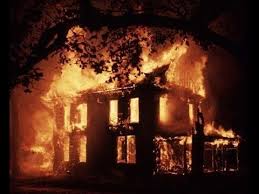
“Ruins!
Nothing but ruins,” George shouted, getting out of his car.
Arm-in-arm
they walked toward what was once a grand old estate.
“I
could have sworn this was the spot,” George said, as he stood in
the middle of the burnt debris.
“No,
it must have been another place,” said a shaken Alice. “That’s
the only explanation … Oh, George! Look! Is that the desk you left
the money in?”
George
hurried over to the badly scarred secretary desk and pulled out the
drawer.
“Oh,
my God … Can you explain it?” mumbled George, holding up an
envelope and the same two twenty dollar bills he had left Mrs.
Jenkins not an hour and a half earlier.*
*Story
adapted from the World Illustrated No 513 1-6.
When
the travelers returned home they told their friends what had
happened. But even when they showed them the envelope with the money
in it, nobody believed their story. Later, after they had spent the
money and destroyed the envelope, they themselves began to doubt it.
Science
has taught us many things about our material world. But what about
the unseen world? What about the world of political intrigue we can’t
see, while being saddled with a main- stream media whose only purpose
is to propagandize what is actually going on?
Many
of the political decisions made by world leaders are too bizarre to
be believed, so they are not believed until it’s too late to
rectify them.
The
words No and
Not are
employed in the restraint of US government power twenty-four times in
the first seven articles of the Constitution
and twenty-two more times in the Bill
of Rights. And yet,
American lawmakers have passed hundreds of thousands of pages of
legislation contravening the basic laws of our land, all adjudicated
to be legal by a corrupted judiciary.
And
in direct violation of the hallowed Separation
of Powers, as
delineated in the Constitution, American presidents began breaking
our basic laws by creating laws rather than merely enforcing them.
These
unconstitutional laws came to be known as EOs (Executive Orders).

The
most egregious Commander-in-Chief to date, in that regard, was
President Abraham Lincoln.
Yes,
the Great Emancipator controlled the Union like a dictator,
exercising autocratic rule by claiming war
powers after the
attack on Fort Sumter, South Carolina. Then, running the federal
government through Executive Orders, Lincoln utterly by-passed the
Congress.
Without
Ole Abe there might not have been an internecine war that denuded
America of over one million of our finest young men, when the entire
US population was not much more than thirty million people.
An
Executive Order (EO) is an order an unconstitutional order
made by a president that has the full force and effect of any laws
constitutionally passed by Congress and signed into law by the
president. This is not Rule
by Law, but Rule
by Men, which
means arbitrary
governance.
Ever
since Lincoln’s administration, and his massive use of EOs
(Executive Orders), he has been both the model and excuse for almost
all succeeding presidents to make up their own laws, to the point
that thousands of such gross violations of our Constitution are now
widely and routinely accepted.
Democratic
President Woodrow Wilson used his EOs to imprison some 5,000
Americans who had opposed his World War I, the war he had promised to
avoid if he were elected president.
It
was Wilson who was the first to declare National
Emergencies, in order
to assume more powers not granted by either our elected Congress or
the Constitution framed by our Founding Fathers.
Our
32nd
president, Franklin Roosevelt, was presented by his “advisors”
with a most clever way for him to expand his power, with the mere
labeling of domestic problems as Wars.
In this way
presidents could cite the war
powers brought into
acceptance by Lincoln, in their pretended wars on drugs, poverty,
racism, anti-Semitism, homophobia, male chauvinism, CO2, or any other
phony excuse to massively expand presidential powers.
Franklin
D. Roosevelt ended up issuing over 3,700 EOs, thus destroying much of
what was left of the US democracy.
We
have a bi-party duopoly that attempts to represent itself as two
distinct political parties, always promoting the trap of the
left/right paradigm.
Please
note how all of our presidents, since Theodore Roosevelt, have all
advanced the globalist, new-world agenda with their EOs.
The
Federal Register and
the Cato Institute
list for us the
number of Executive Orders (not the number of pages) issued by the
20th and some 21st century presidents of Democrats and Republicans:
Theodore
Roosevelt 1,006; William H. Taft 698; Woodrow Wilson
1,791; Calvin Coolidge 1,253; Warren G. Harding 484; Herbert
Hoover 1004; Franklin D. Roosevelt 3,723; Harry S. Truman
905; Dwight D. Eisenhower 452; John F. Kennedy 214; Lyndon B.
Johnson 324; Richard M. Nixon 346; Gerald R. Ford 169;
Jimmy Carter 320; Ronald Reagan 381; George Bush I 166;
Bill Clinton 364; and the numbers of EOs signed by presidents
continued from there.
But
there are also wicked Presidential
Directives, which are
a form EO, issued by a president with the advice and consent of the
unelected National
Security Council, which
have the full force and effect of constitutionally passed laws.
But
the real kicker is these directives are classified, using the old
“national security” ruse. This is how America, now secretly, but
officially, tortures human beings in military bases all over the
world torture in the name of every American, living or dead.
Back
in 1916, Democratic President Woodrow Wilson began creating many of
today’s federal agencies by the use of Executive Orders, each of
which has ballooned to about the size of a large government, each
headed by un-elected directors, and each issuing their own orders and
directives, which have the full force and effect of legal laws.
One
such agency, the Internal Revenue Service, enforces their tax code
that is over 60,000 pages long, and growing.
Moreover,
Americans today are burdened with thousands of pages of Presidential
Review Directives (PRDs), Presidential Decision Directives (PDDs),
National Security Reviews (NSRs), National Security Directives
(NSDs), National Security Presidential Directives (NSPDs), and
Homeland Security Directives, all having the full force and effect of
law, and all in additions to EOs and the thousands of pages of laws
passed by Congress.
In
order to maintain the illusion of a democracy, we are still allowed a
presidential election every four years; and no one president can
serve more than two four-year terms.
But,
it is not any one president who has become a dictator; it is the
Office of the Presidency, and those faceless autocrats in the
Executive Branch who control the office of the presidency, who are
the dictators, without many of us ever knowing it.
No,
we are hardly a democracy. Our beloved United States of America has
become a fascist state and will remain so until a majority of
Americans come to realize the sad state of our ship-of-state.
Executive
Orders are the hallmarks of fascistic tyranny. So, why do we have
them?
Can
you explain it?
J.
Speer-Williams
Jsw4@mac.com
|
