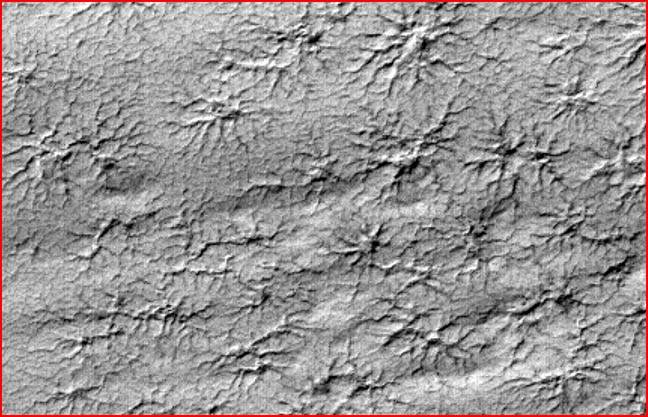
- Most of the branching of the spidery ridges
at the Martian south pole follows the Fibonacci pattern, a pattern that
has no reference in familiar geological events. Credit: NASA/MOC
-
-
- The remarkable Martian formations called "spiders"
occur only at the planet's south polar region. But some observers distinguish
between those spiders which appear as permanent features of the surface,
and those which seem to emerge and disappear seasonally.
-
- A groundbreaking study by C.M. Orme and P.K. Ness, published
in the February 8, 2002 issue of the Journal of the British Interplanetary
Society, examines the spiders in detail. (The authors titled their study
"Spider Ravine Models and Plant Like Features on Mars -- Possible
Geophysical and Biogeophysical Modes of Origins.")
-
- A subsequent study by Orme and Ness, developed in consultation
with renowned science fiction writer Arthur C. Clark (available at New
Frontiers), concentrated on the enigma of the changing spiders, suggesting
that the comings and goings of active variants constitute one of the most
profound mysteries ever presented to planetary scientists.
-
- Though the authors do not assert a final position on
the subject, their lines of reasoning imply that a biological origin may
be the only explanation not excluded by the visual evidence. Orme and
Ness note that, in contrast to the permanent spiders, which include substantial
ravine networks, changing spiders all involve material raised above the
surrounding surface. The branching of these formations presents well-defined
ridges, as seen in the picture above. But mysteriously, the active spiders
grow and retreat seasonally-even appear to dissolve completely into the
surrounding terrain -- the very attributes one might expect of vegetation.
-
- But the biological interpretation runs into a seemingly
insurmountable problem. It is not reasonable to suggest that active and
inactive spiders are created by unrelated forces. Inactive spiders, a
permanent part of the visible landscape, are clearly-cut ravines. There
is simply no basis for suggesting a biological character of these permanent
ravine networks. Surely, a credible explanation of the active spiders
cannot ignore the inactive spiders.
-
- The distinctive branching pattern is fundamental to the
authors' argument: "The branching (bifurcating) structure of roots,
shoots, veins on leaves of plants, etc., have similarity in form to branched
lightning strokes, tributaries of rivers, physiological networks of blood
vessels, nerves and ducts in lungs, heart, liver, kidney, brain etc. Such
seemingly complex network structure is associated with exquisitely ordered
beautiful patterns exhibited in flowers and arrangement of leaves in the
plant kingdom." The reasoning here tends to link branching structure
most "exquisitely" with living systems, though lightning strokes
and tributaries of rivers also reveal branching patterns.
-
- But Orme and Ness properly note that the mathematical
pattern of "Fibonacci" branching is not typical of river networks,
except by chance. River networks are constrained by random topography
in ways that preclude the mathematical pattern.
-
- What, then, of lightning? The authors contend that "Fibonacci
patterns are never found in non-biological phenomena." But this statement
is clearly not correct. In Part 1 of this series we noted the "arachnoids"
on Venus, identical in both name and morphology to the Martian spiders.
In Part 2 of this series we presented a Lichtenberg figure created by
an electric arc on a negatively charged surface. It shows undeniable Fibonacci
branching. We also noted the Lichtenberg pattern of a lightning strike
on a golf course, with prolific branching remarkably similar to that of
the Martian spiders.
-
- Though most treatments of the spiders emphasize temperature
variations affecting surface ice (water and/or CO2), evidence presented
by Orme and Ness systematically excludes the possibility that spiders
are made of CO2 or water ice.
-
- "Whatever the spiders are made of, it stands to
reason that the same materials must be found elsewhere on the South Pole.
For example, if the spiders are made of CO2 or water ice, then other known
ice nearby should also be in similar unusual formations....The spiders
tend to form in early spring and fade away in autumn...The spiders are
forming as the CO2 is usually already gone and the ground becomes frost
free, and the spiders are shrinking when ice and frost are returning to
the ground. If they are made of ice, then it needs to be explained why
they are affected by temperature in the opposite way known to ice."
-
- But the authors appear to have missed a key to the solution,
one in which we have sufficient confidence to assert a prediction: Both
the active and inactive spiders are part of the permanent Martian topography
at the south pole. What distinguishes the one class from the other is
the relative depth of ice covers in the Martian winter. Following this
reasoning, the growth of the active spiders in the spring would be nothing
more than the effect of sublimation and Martian winds progressively removing
snow and ice layers to expose the Lichtenberg ridges. The ridges themselves,
we suggest, are not changing in any appreciable way. They are constituted
of surface material glassified by high-energy electrical arcs striking
the south polar region. In this interpretation, as snow or ice returns
in the fall, the shallow spidery ridges appear to dissolve back into the
terrain.
-
- Could the explanation really be this simple? There is
every reason to explore the electrical interpretation, and NASA's disregard
of electric possibilities remains a continuing disservice to the public,
though it is the public that provides the funding on which all of NASA's
activities depend.
|