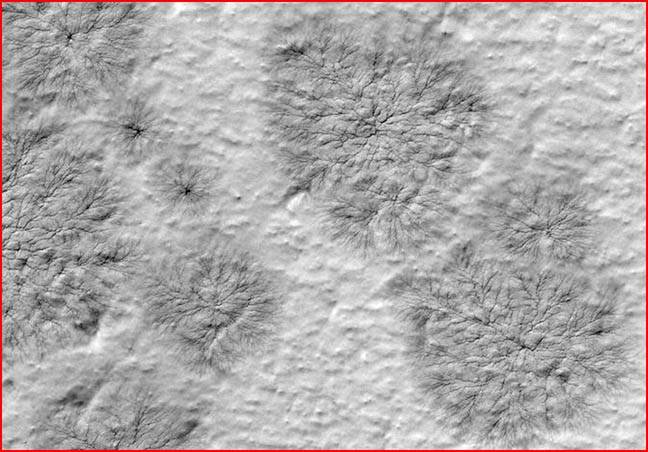
- Geologists have dubbed these formations at
Mars' southern pole "spiders." But no one seems able to explain
them. Credit: NASA/Mars Global Surveyor
-
-
- The discovery of complex dendritic networks at Mars'
south pole has left NASA scientists scrambling for answers. What are these
bizarre formations, and how were they created?
-
- For two years on this website, we have explored the anomalous
surface features of our nearest planetary neighbor, Mars. No other body
outside of the earth has been more closely examined by planetary scientists
than this "Planet of a Thousand Mysteries." Numerous surface
features find no analogy in familiar geology. And even those features which
geologists claim to recognize, when examined in context and in detail,
defy textbook definitions. It is only necessary to look closely to see
that this is so.
-
- The anomalies begin with the most prominent features,
Olympus Mons and Valles Marineris, but extend to every region of the Martian
surface. The unexplained patterns include (but reach far beyond): giant,
circular craters with layered terraces, concentric rings and shallow flat
floors; dense (non-random) populations of craters in regions of burned
and darkened soil; strings of craters placed amidst sharply cut scoops
and gouges, suggesting material removed by an "unknown" force;
"inconceivable" spheres and/or domes resting inside craters;
elevated craters whose floors stand higher than the surrounding terrain;
braided, interweaving, flat-floored channels, revealing no evidence of
either surface faulting or flowing liquid; layers of surface exhibiting
dense populations of bb-sized spherules, called "blueberries,"
apparently occupying the Martian surface by the trillions. While conventional
geologists struggle to explain these paradoxes, proponents of the Electric
Universe view the Martian landscape as a laboratory in space, demonstrating
the varieties of electrical discharge effects.
-
- As noted in a previous Picture of the Day, Olympus Mons
meets every test of an anode blister (a discharge effect on a positively
charged surface); Valles Marineris exhibits the defining features of an
electric arc tearing across a surface. The dense populations of craters
and burnt surfaces are replicated with laboratory arcs, right down to the
central bumps or peaks. Even the Martian "blueberries" have been
precisely replicated by electric arcs in the lab, in experiments performed
by plasma physicist CJ Ransom. And when scaled upward, these lab-created
"blueberries," resting in the center of electrically produced
craters, provide a compelling analog to the "impossible" domed
craters on Mars.
-
- Why then have planetary scientists not even noticed the
success of the electrical hypothesis? The reason is that this hypothesis
asks them to consider the theoretically "unimaginable," to set
aside the foundations of modern planetary science. It asks them to envision
an unstable, electrically active solar system in the past, when Mars was
engulfed by electrical discharge, its every region carved by electric arcs
raking across its surface.
-
- The electric theorists believe that systematic examination
of the Martian landscape will confirm their hypothesis beyond any reasonable
doubt. And they are eager to test the predictive ability of the hypothesis
at every available opportunity.
-
- One such opportunity may now be at hand in the case of
the amazing "spiders" on Mars.
-
- Discovered in 1997 by NASA's Mars Global Surveyor, hundreds
of these configurations have been imaged in Mars' south polar region (the
only region where they occur). In each instance the configurations originate
from a single center, spreading dozens of "branches" over an
area that averages about 985 feet across. (See picture above.) The formations
have left scientists baffled. "We're still scratching our heads over
how these things are forming," says Anthony Colaprete of NASA's Ames
Research Center in Mountain View, California. "They're unlike anything
we have on Earth."
-
- Some investigators have suggested that the spiders are
dendritic drainage channels. But one characteristic that makes the formations
so difficult to explain is the way they "work against" gravity.
In fact, the branching occurs radially from a center, positively excluding
a drainage function. Moreover, the spiders form in identical shapes irrespective
of the terrain. Often, a single ravine is seen moving both uphill and down.
And many of these radial patterns occur on a consistent incline.
-
- Others suspect that the "spiders" are caused
by sublimation of CO2 hidden under the soil. A variation of this explanation
was proposed in a recent issue of Astronomy magazine (July, 2006). But
CO2 is known to be present in abundance in south polar regions that do
not exhibit spiders, and throughout the north polar region which exhibits
no spiders. No sublimation process has ever been observed that produces
the consistent branching pattern (called Fibonacci branching ) of these
bizarre forms.
-
- So what are the Martian "spiders"? Interestingly,
there is an analogy on another planet, but it is never mentioned. Stretching
around the equator of the planet Venus is a vast display of what planetary
scientists call "arachnoids." Indeed, these overlying formations
display more finely filamented branching ravines than the "spiders"
on Mars. But there is a reason why planetary scientists have not concerned
themselves with the similarities in both name and morphology. Why would
they compare formative processes at a frigid pole of Mars with formative
processes on Venus, where temperatures exceed nine hundred degrees Fahrenheit?
-
- In electrical terms, of course, the considerations that
preclude a comparison of Mars and Venus no longer apply. Therefore, we
shall take up the electrical interpretation of Martian "spiders"
in our Picture of the Day for July 26.
|