On Monday, October 31,
1938, Americans listening to CBS network radio, expecting to hear the anthology
drama Mercury Theatre of the Air, were puzzled by the sound of orchestra
music. Suddenly, a newscaster broke in and announced, "Ladies and
gentlemen, I have just been handed a message that came in from Grover's
Mill by telephone....Just a moment... At least forty people, including
six state troopers, lie dead in a field east of the village of Grover's
Mill (New Jersey--J.T.), their bodies burned and distorted beyond all recognition." On Monday, October 31,
1938, Americans listening to CBS network radio, expecting to hear the anthology
drama Mercury Theatre of the Air, were puzzled by the sound of orchestra
music. Suddenly, a newscaster broke in and announced, "Ladies and
gentlemen, I have just been handed a message that came in from Grover's
Mill by telephone....Just a moment... At least forty people, including
six state troopers, lie dead in a field east of the village of Grover's
Mill (New Jersey--J.T.), their bodies burned and distorted beyond all recognition."
-
- Stunned listeners sat by their Atwater
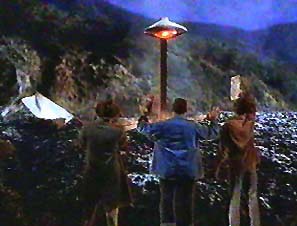
Kent radios, hearing newscasters describe "strange meteors" falling
out of the sky, ovoid objects with tripod legs looming above the maple
trees, and clouds of "sinister luminous gas" moving forward relentlessly.
Actually, it was just a radio play. H.G. Wells's classic War of the Worlds
rewritten in "radio news" format by Mercury Theatre producer
Orson Welles. But audiences all around the USA thought it was real. "Good
heavens, something's wriggling out of the shadows like a gray snake. Now
it's another one and another. They look like tentacles to me. There,
I can see the thing's body. It's as large as a bear and it glistens like
black leather. But that face... it's indescribable...The eyes are black
and gleam like a serpent. The mouth is V-shaped with saliva dripping from
its rimless lips..."
-
- By now, telephones were ringing in police
stations all over the USA. In Chattanooga, Tennessee, a Presbyterian congregation
fell to its knees and began singing What A Friend We Have in Jesus. In
Indianapolis, Indiana, a woman who had been listening to the broadcast
burst into a church and shouted, "New York has been destroyed! It's
the end of the world! Go home and prepare to die!" In Providence,
Rhode Island, police received over 4,000 calls from anxious listeners.
(Editor's Comment: That's not surprising. One month earlier, on September
21, 1938, Rhode Island had been devastated by the Hurricane of 1938. After
you've seen the impossible--a 20-foot storm surge gushing down Weybosset
and Westminster Streets, and 1937 Packards bobbing around like clumps of
seaweed, a Martian invasion doesn't seem beyond the realm of possibility.)
-
- In Newark, New Jersey, people climbed
onto apartment house rooftops and, looking across the Hudson River, saw
clouds of smoke over Brooklyn and the Bronx. Rumors spread like wildfire.
The Martians were dropping poison gas on New York City! Hundreds fled
Newark, causing massive traffic jams. In Grover's Mill, N.J., seven duck
hunters, listening to the CBS broadcast on a car radio, decided to fight
back. They formed a patrol and headed into the woods. Suddenly, one of
them cried out and pointed to a sinister ovoid shape looming above some
trees. "It's one of them Martian war machines."
-
- "Give 'em hell, boys!" The
group opened fire with rifle and shotguns, but it was no good. The object
remained in place. Then one of the men, who owned a Browning Automatic
Rifle (B.A.R.) remembered that he had two or three clips of armor-piercing
ammunition in his ruck. He slid in a clip and opened fire. A hundred yards
away, a New Jersey state trooper heard all the shooting and stopped his
car. As he made his way through the woods, he heard the distinctive chum-chum-chum
sound of the B.A.R., followed by an anguished scream, "Martian blood!
I'm covered with Martian blood!" Arriving at the scene, the trooper
found the group huddled around their soaked and hysterical companion and
said, "What are you assholes doing!?"
-
- "We just knocked out a Martian war
machine," one replied. "Poor Frank's got Martian blood all over
him."
-
- Taking out his flashlight, the trooper
aimed it in the direction indicated. He switched it on, and the beam showed
the Grover's Mill municipal water tower, with gallons streaming from the
bullet holes in the round steel tank. Back in New York, police detectives
invaded the CBS control room, advised executives of the panicky situation,
and Orson Welles himself took the microphone.
-
- "This is Orson Welles, ladies and
gentlemen, out of character to assure you that The War of the Worlds has
no further significance than as the holiday offering it was intended to
be. The Mercury Theatre's own radio version of dressing up in a sheet
and saying Boo!...we couldn't soap all your windows and and steal all your
garden gates by tomorrow...so we did the next best thing. We annihilated
the world before your very ears and utterly destroyed the Columbia Broadcasting
System. You will be relieved, I hope, to learn that we didn't mean it,
and that both institutions are still open for business. So, goodbye, everybody,
and remember, please, for the next day or so, the terrible lesson you have
learned tonight. That grinning, glowing, globular invader of your living
room is an inhabitant of the pumpkin patch, and if your doorbell rings
and nobody's there, that was no Martian...it's Halloween."
-
- For weeks afterward, commentators and
columnists talked and wrote about the "Martian broadcast." The
Times of London tracked down the elderly Herbert George Wells and asked
what he thought about the panic in America. Wells's reply: "How odd."
The day after the broadcast, CBS president William S. Paley's office was
invaded by a species even more fearsome than Martians... namely lawyers.
But that's another story. (See the New York Daily News for November 1,
1938, "Fake Radio 'War' Stirs Terror Throughout U.S." Also ROSEBUD:
THE STORY OF ORSON WELLES by David Thompson, Alfred A. Knopf Inc., New
York, NY 1996, page 104, and ORSON WELLES: THE ROAD TO XANADU by Simon
Callow, Viking, New York, NY, 1995, pages 402-404.")
|