| 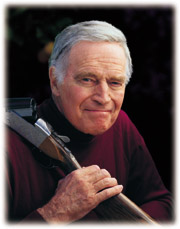 LOS ANGELES (Reuters) - Charlton
Heston, the Oscar-winning actor and head of America's biggest gun lobby,
revealed on Friday that he is in the early stages of what appears to be
Alzheimer's disease and vowed not "to give up." LOS ANGELES (Reuters) - Charlton
Heston, the Oscar-winning actor and head of America's biggest gun lobby,
revealed on Friday that he is in the early stages of what appears to be
Alzheimer's disease and vowed not "to give up."
In a video-taped announcement played at a Beverly Hills
news conference, the 78-year-old president of the National Rifle Association
said he was going public with his illness after having "lived my whole
life on the stage and screen before you."
"For an actor there is no greater loss than the loss of his audience,"
said Heston, famed for his role as Moses in Cecil B. DeMille's epic "The
Ten Commandments." "I can part the Red Sea, but I can't part
with you, which is why I won't exclude you from this stage in my life."
Former President Ronald Reagan ( news - web sites), an old friend of Heston's,
disclosed in November 1994 that he had been diagnosed with Alzheimer's
disease, an incurable brain disease that causes memory loss in its early
stages and ultimately leads to death.
Heston said that for now he would continue living a normal life but added,
"If you see a little less spring in my step, if your name fails to
leap to my lips, you'll know why. And if I tell you a funny story for the
second time, please laugh anyway."
A spokesman, Tony Makris, told reporters Heston still plans "a very
ambitious campaign schedule" going into this fall's mid-term congressional
elections and has a movie deal in the works, but he declined to give details.
"He chose this method of communication after agonizing for a few days,"
Makris said.
'A FEW WORDS NOW'
Heston said his doctors had recently told him he had a "neurological
disorder whose symptoms are consistent with Alzheimer's disease. So I wanted
to prepare a few words for you now because when the times comes, I may
not be able to."
The square-jawed performer won an Oscar as best actor for his title role
in the 1959 gladiator epic "Ben-Hur." Other notable film roles
include Michelangelo in "The Agony and the Ecstasy," John the
Baptist in "The Greatest Story Ever Told," an astronaut trapped
in a strange world in "Planet of the Apes," and a circus manager
in "The Greatest Show on Earth."
A former president of the Screen Actors Guild, Heston has been a leading
figure in the national debate over gun control as president of the NRA,
America's most powerful gun lobby. His fifth one-year term as NRA president
ends in April 2003.
NRA Chief Executive Officer Wayne LaPierre later said
members of his group "are happy to see him fill out his term and see
him out on the campaign trail."
"His role goes to leadership, inspiration, motivation and moral guidance,
and we'll continue to look to him for that."
Expressions of sympathy came from one of Heston's main foes in the debate
over gun control, Sarah Brady, whose husband was wounded in the assassination
attempt on Reagan.
"We are saddened by Mr. Heston's announcement," she said in a
statement. "We understand how painful Alzheimer's disease can be for
those suffering >from it and for their loved ones."
Likewise, Americans for >Gun Safety President Jonathan Cowan saluted
Heston as a "worthy adversary in the gun debate" and said "our
hearts go out to Mr. Heston and his family."
SWITCHED TO RIGHT FROM LEFT
Heston was active in the civil rights movement and campaigned for Democrats
Adlai Stevenson and John Kennedy in their presidential bids. But he switched
to Republican Richard Nixon in 1972 and backed Reagan in his first quest
for the White House in 1980. Thereafter, Heston was identified with conservative
politics and causes.
Heston invoked the names of slain civil rights leader
the Rev. Martin Luther King Jr., and former presidents Kennedy and Reagan
in his remarks on Friday.
"I'm neither giving up nor giving in," he said. "I'm still
the fighter that Dr. King and JFK and Ronald Reagan knew, but it's a fight
I must someday call a draw."
Alzheimer's affects an estimated 4 million Americans and 12 million worldwide.
It causes dementia, once known as senility, and becomes more common as
people age.
Marked by messy tangles and clumps of dead cells in the brain, Alzheimer's
has no cure and is always fatal. It starts out with minor symptoms of memory
loss, but patients become increasingly confused.
They can lose their way in once-familiar neighborhoods and eventually become
unable to care for themselves, needing help dressing, eating and bathing.
A patient lives an average of eight to 10 years after diagnosis, although
some people survive for as long as 20 years.
There are drugs that can help treat the symptoms of the disease although
none have any long-term benefit.
Copyright © 2002 Reuters Limited. All rights reserved.
Republication or redistribution of Reuters content is expressly prohibited
without the prior written consent of Reuters. Reuters shall not be liable
for any errors or delays in t |
